
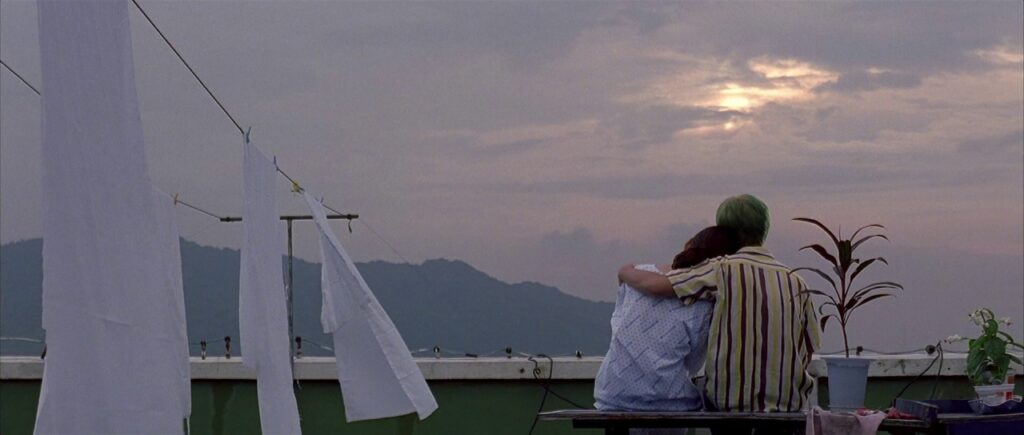

“Sympathy for Mr. Vengeance” follows Ryu (Shin Ha-kyun), a mute factory worker who is let go from his job and thus can no longer pay for his sister’s kidney transplant. He even tries to sell his own kidney for money, as his blood type doesn’t match that of his sister’s, only to get betrayed by an organ trafficking ring who end up taking his kidney and the rest of his money. Desperately in need of cash, he turns to kidnapping the daughter of his prior employer, Dong-jin (Song Kang-ho), intending to ransom her. From there, we see a series of unfortunate events and miscommunications that all come together to create a bleak picture about the senselessness and futility of vengeance.
Usually when you see a revenge film, you are presented a side that you can care about and root for; like the Bride in “Kill Bill”. You come to understand their pain and anger, and there can even be a catharsis in seeing them finally get what they want. However, in “Sympathy for Mr. Vengeance” there is no hero or villain, there is no moral center that the film aligns with. Rather, we see how modern society can push people to violent extremes. And even still the violence here is never stylized or triumphant, and those who commit it never really get what they want. The revenge that we are presented here feels hollow, brutalistic, and cruel. There is no satisfaction, and by the end of it you feel a lingering sense of hopelessness and sympathy for everyone involved in this mess.
Park Chan Wook along with other Korean filmmakers (Bong Joon Ho, Lee Chang Dong, Kim Ki Duk to name a few), were part of the Korean New Wave that came into form in the late 1990s and early 2000s. Prior to the 1980s, Korea was ruled by authoritarian regimes that placed strict censorship over film. After South Korea transitioned to a democracy those censorships on film were removed. Then around 1997, South Korea faced a severe financial collapse known as the IMF crisis that resulted in mass layoffs, familial instability, and a loss of faith in corporate loyalty. Many of the films of the Korean New Wave focused on themes of institutional failure and moral ambiguity, much of which we see in Park’s “Sympathy for Mr. Vengeance”.
Ryu’s silence in the film represents how the voice of the working class goes unheard. Even the wealthy Dong-jin faces institutional failures with the police, who only seem to arrive after it’s too late. There are many points in the film where we see violence erupt not out of any goodness or evil, but from a need to take matters into your own hands. Similar themes also show up in Park’s latest film “No Other Choice”, where a recently fired employee goes to violent extremes in order to secure a new job. However, “Sympathy for Mr. Vengeance” is a much bleaker story.
The characters are often framed small against their environments, and scenes tend to go on in long, still shots. We are forced to passively observe the things that are happening and have a sense of emotional distance. This can make the film extremely difficult to view at times, and it is not a light watch by any means and not one that I will come back to again in a long time. And that’s not so much a criticism of the work, but a defining feature of it. By the end you simply feel numb to what you have seen and are stunned by the new horrors that modern society has created.
“Sympathy for Mr. Vengeance” is perhaps the darkest film that I have seen Park make, and it’s no surprise that a film like this didn’t hit it off at the box office either. But I have to admire it for being so bold and adventurous, and presenting a contrast to the usual violence and revenge that we see. This is also the first film in what would become his revenge trilogy, with the other two films being “Oldboy” and “Lady Vengeance”.