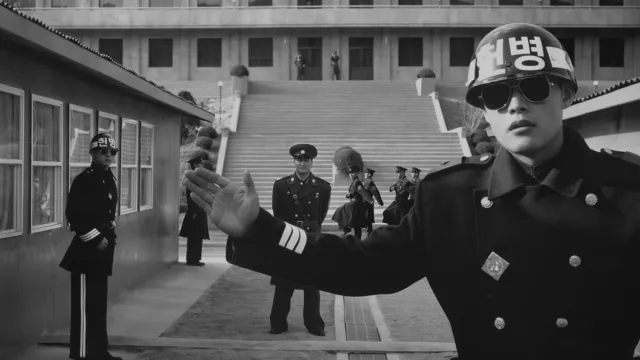

Park Chan-wook’s “JSA” (Joint Security Area) centers on a bond that develops between people who have been taught to hate each other. The backdrop for the film is the DMZ (Demilitarized Zone) separating North and South Korea; a space defined by rigid rules, surveillance, and the threat of sudden violence. Here, we see a friendship blossom between North and South Korean soldiers. There have been countless stories about forbidden relationships; however, “JSA” distinguishes itself by grounding its story in a real geopolitical conflict that continues to shape modern history.
That “JSA” revolves around an arbitrary dividing line, one created by external forces attempting to exert influence over the Korean peninsula, only further elevates the film. Within this framework, we see that soldiers on both sides of line are quite similar despite their extreme political differences. In this way, “JSA” is not only about broken relationships between individuals, but about a common people fractured into opposing identities. The real tragedy here is how fragile personal connection is when confronted with political and institutional power.
Park deliberately avoided any direct statements regarding Korean history, stating that he was less interested in assigning blame than in exploring the emotional consequences of the division. Because of this, it also becomes clear that the violence which erupts in the film is not something uniquely Korean, but an extension of universal human tendencies towards tribalism and obedience. These soldiers do not kill out of hatred so much as out of fear, confusion, and a pressure to perform their assigned roles.
I decided to watch this film after seeing Park’s latest film, “No Other Choice”; a masterful work brimming with some of the most visually stunning camerawork I’ve seen this past year. However, by comparison, “JSA” is much more restrained work. The camera is largely static, whereas in his later work it has no trouble flying about in extended takes. That said, Park has always been known for juggling tonal extremes and his mastery over this is present here. Moments of warmth and humor are paired with an underlying violence and tension that makes these sequences feel uniquely uneasy.
“JSA” also doesn’t feel as refined as Park’s later films. The English dialogue, unfortunately, sticks out like a sore thumb. Structurally, the film opens with a murder and a fragmented investigation, similar to “Rashomon”. However, this ambiguity is abandoned quite early on when we are presented with a long flashback sequence revealing what truly happened. What is initially a mystery looses its mysteriousness, and the film moves towards being about a moral tragedy.
It’s also worth noting that at the time of its production, “JSA” was one of the most expensive films South Korea had ever made. Largely because Park was unable to shoot at the actual Joint Security Area, and so the production had to recreate the set from scratch. Despite this, the film became a massive box office success, establishing Park as a major director well before his international breakthrough with “Oldboy”.
“JSA” also marks the first collaboration between Park and the great actor Song Kang-ho (who he would later work with again on “Thirst”), as well as actor Lee Byung-hun (who recently reunited with Park on “No Other Choice”). Song in particular brings an incredible ability to toe between the film’s different tones. He brings a warmth and humor to this role while also portraying a character who is the most battle-hardened of the group.
All that being said, I really enjoyed watching “JSA”, and I can only imagine the significance a film like this holds for a Korean audience. It is a daring film that asks difficult questions, something Park’s work has continued to do to this day.