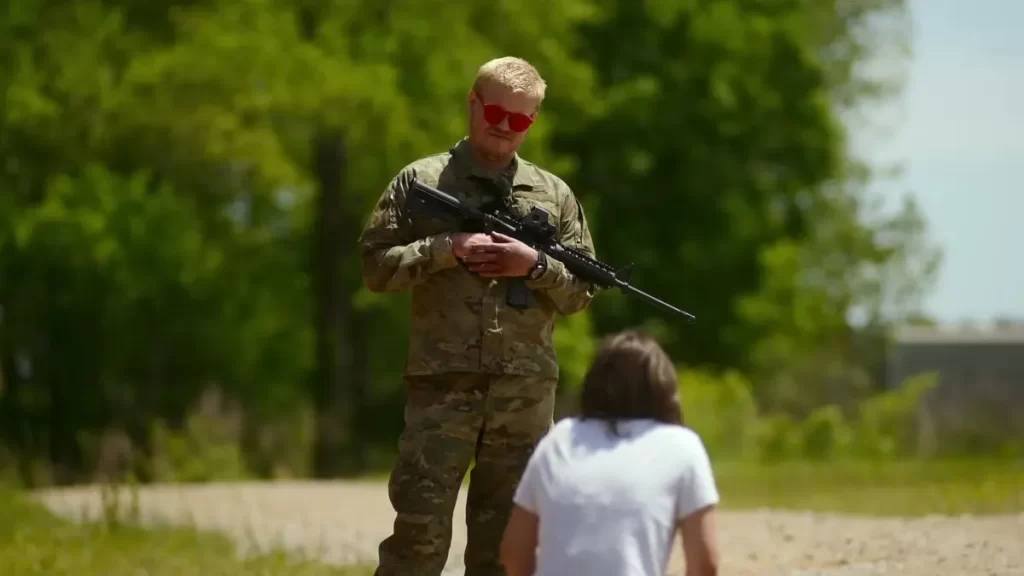

“Civil War” centers around a group of war journalists as they navigate an American landscape torn apart by itself. Journalist Lee (Kristen Dunst) is hoping to get an interview with the current sitting President (Nick Offerman) before rebel groups descend upon the capital. This leads her, a few of her colleagues, and an aspiring war journalist (Cailee Spaeny) to go on an “Apocalypse Now”-esque journey from NYC to Washington, D.C. On the way they encounter grizzly sites and even grizzlier people (looking at you Jesse Plemons).
Them being a band of war journalists, they try to photograph and document everything they see, and this is ultimately what “Civil War” is about. It centers on the idea of documenting horrors and how much of your humanity you are willing to dampen in order to get the shot. The young aspiring war journalist is at first unable to take pictures of the horrible things she sees, but Lee later tells her that her job is not to analyze the situation: “Once you start asking those questions you can’t stop. So we don’t ask. We record so other people ask”. But how much do we record? Are you willing to snap a picture of your friend’s corpse? At what point do you stop recording and intervene? As the characters navigate the American countryside they are challenged with questions such as these and other ethical dilemmas.
Lee is an accomplished journalist who has PTSD from the wars she documented oversees; however, seeing similar violent atrocities being committed in her own country hits different. There is this interesting chromatic aberration that occurs when Lee’s PTSD is being triggered, sometimes we see it during flashbacks and other times during the horrors she encounters on this journey. This effect is used to its full potential when at the end, the young aspiring journalist also has this chromatic aberration effect signaling that like Lee she has now endured a traumatic event that will likely haunt her. Continuing the cyclical nature of trauma.
I liked how we were seeing this war through the eyes of a band of journalists. While it’s made clear they don’t like the president, they do not have a side they are fighting for. They photograph perspectives on both sides of the aisle, sometimes it’s not even clear whose side some people are on (looking at you Jesse Plemons). This seems to have been intentionally kept vague and as a result what becomes very clear is the horror of war. When there isn’t a side that you are on, war is nothing but destructive. In that sense “Civil War” is a true anti-war film where the thrill of having a side winning or losing is completely taken out of the picture.
Alex Garland wisely keeps politics vague in the film. It is not made clear exactly why this civil war is happening (though perhaps one can guess it is because the President became tyrannical and attacked his own people). Nevertheless, these political lines blur and it isn’t exactly clear what each side is fighting for apart from that they are fighting and that someone must die in order for it to stop. There is this incredible sequence where our band of journalists encounter an almost surrealistic winter wonderland display in the middle of a road during a beating summer heat. They are shot at by a sniper in a house located nearby and as they run into hiding, they encounter another sniper group trying to take out the sniper in the house. When asked if they have seen who is in the house or what side he may be on, they say it doesn’t matter and that “someone is trying to kill us, we are trying to kill them”. Instances of this kind of senseless violence appear constantly throughout the film, making it hard for the audience to truly connect with any one side.
It’s unfortunate that a film like this was not as recognized as it should have been when it first came out; however, I also don’t think this is entirely on the audience. Naming a film “Civil War” during an election year where the possibility of a tyrannical president taking office was a provocative choice. Having California and Texas aligning together is so brazen in this current political atmosphere that not addressing this topic would inevitably lead to frustration among the audience. The trailer also gives an impression of a very different film than what we see. So much so that even I was thrown off when it became clear what this film is trying to do. However, I am not here to judge an ad campaign, I’m here to judge the film, and I admire it for remaining vague in these aspects. At the end of the day, Alex Garland’s “Civil War” is an extremely well-made, effective, and horrifying film. I suspect that it will age better with time as either the depiction of a tyrannical president comes true or the current political divisiveness cools off and viewers can actually appreciate what this film is trying to say.